> For the complete documentation index, see [llms.txt](https://methodological-notes.gitbook.io/methodology/llms.txt). Markdown versions of documentation pages are available by appending `.md` to page URLs; this page is available as [Markdown](https://methodological-notes.gitbook.io/methodology/recon-strategies-by-other-hackers/how-i-hacked-nasa-and-got-8-bugs.md).
# How I hacked NASA and got 8 bugs ?
source: https\://medium.com/@shari7a0x/how-i-hacked-nasa-and-get-8-bugs-e5cd397a6af9
Hi hackers ,
I will explain , How did i get 8 bugs in NASA .
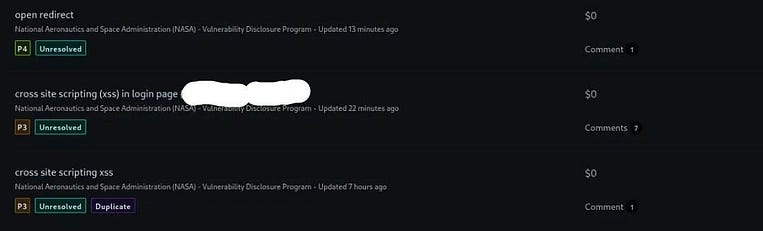
It’s about 7 cross site scripting (xss) and one open redirect .
First step collect subdomains and check live domains .
I always use tool [**subfinder**](https://github.com/projectdiscovery/subfinder) and add to it some API’s .
I always use tool **HTTPX** .
```
subfinder -d host.com -silent | httpx -mc 200 -o live txt
```
second step collecting parameters .
I always use two tools [**paramspider**](https://github.com/devanshbatham/ParamSpider) and [**waybackurls**](https://github.com/tomnomnom/waybackurls) .
wait , are you real to collect parameters form domains by yourself ?
it’s many subdomains and paraspider can’t automate this alone .
I use simple bash script ,to automate collect parameters from subdomains .
```
for URL in $( little not before run this script you should open directory of Paramspider .
**what after this ?**
You want to check parameters if you can add (tags <>) .or not
I used [**KXSS**](https://github.com/Emoe/kxss) **,** it’s very nice tool but not work at all the time .
```
Cat parameters.txt |kxss
```
done .
what after this ?
I can write html code .
You can use tool for discovering hidden parameters also like [**Arjun**](https://github.com/s0md3v/Arjun) and check parameters if it work, you can use tool like [**dalfox**](https://github.com/hahwul/dalfox) very cool tool .
```
Arjun -u host.com
```
```
Dalfox url host.com?parameters=xss
```
boom xss is done .
You can use automation by [**NUCL**](https://github.com/projectdiscovery/nuclei)**EI .** [**templates**](https://github.com/projectdiscovery/fuzzing-templates) **.**
```
Nuclei -l parameters -t /fuzzing-templates/xss
```
I get open redirect by NUCLEI .
```
cat parameters.txt | grep "redirect" | NUCLEI -t /fuzzing-templates/redirect/open-redirect.yaml
```
if you think i finish you are wrong .
lol .
but that are two bug only , where are others ?
after i got first xss i had an idea , i can use some google dorks .
google dorks for xss !!!! yep .
some google dorks for discovering parameters
site:\*.host.com ext:asp
site:\*.host.com ext:jsp
site:\*.host.com ext:aspx
site:\*.host.com ext:jspx
site:\*.host.com ext:do
site:\*.host.com ext:action
I use them but didn't have useful parameters .
I check subdomain if i can use it to search about it in google .
I found something doesn’t see it usually it’s **`index.cgi .`**
I asked myself why didn’t try to use google dorks about it .
site: \*.host.com ext:cgi
site:\*.nasa.gov inurl:index.cgi
I see good result , i checked this result it’s like last domain ,that i had found xss in it ,I tried to use same parameter lol it is working nice .
I checked about 11 domains but 7 had xss .
thinks for reading .
give me feedback .
can you follow me in [**linked in**](https://www.linkedin.com/in/shai7a0x/) and [**twitter**](https://twitter.com/Shari7a0X)